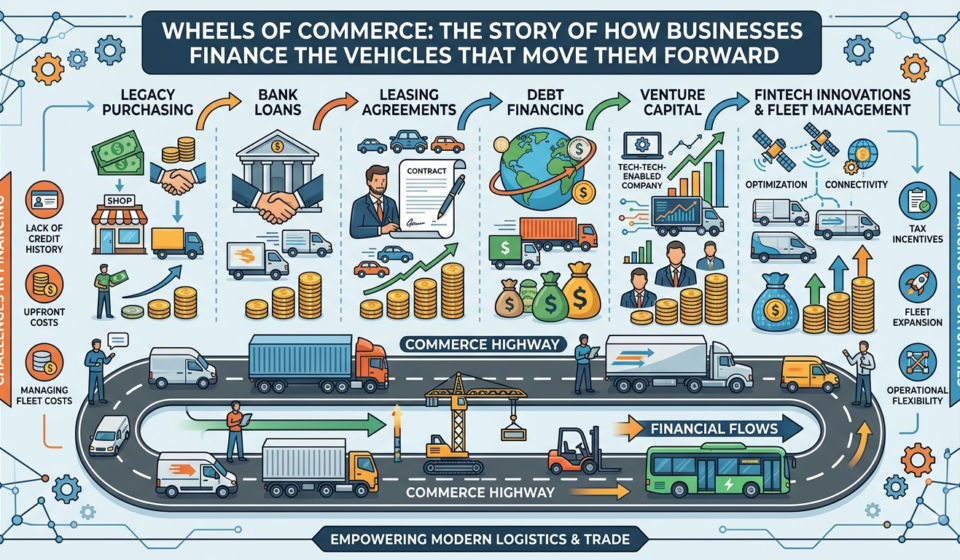
Wheels of Commerce: The Story of How Businesses Finance the Vehicles That Move Them Forward

Anúncios
Long before a package arrives at a doorstep, before produce reaches a grocery shelf, before a plumber reaches a customer’s home, something has to move. Goods, tools, people, and services all depend on vehicles, and vehicles, particularly the kind built for commercial use, rarely come cheap. A single delivery van, box truck, or heavy-duty rig can cost as much as a house, and most businesses, especially smaller ones, simply cannot pay that sum upfront without draining the cash they need to keep everything else running.
This is the exact problem that commercial vehicle loans were built to solve. They allow businesses to acquire the trucks, vans, buses, or specialized vehicles they need to operate, while spreading the cost over time instead of paying it all at once. Though it might seem like a narrow financial product, its history is tightly woven into the story of transportation itself, evolving alongside every major shift in how goods and people have moved across cities, countries, and continents.
Anúncios
A Brief History of Commercial Vehicle Loans
The Horse-Drawn Origins of Vehicle Financing
Before engines existed, commerce still depended on vehicles, just of a very different kind. Merchants, farmers, and tradespeople relied on horse-drawn wagons and carts to move goods, and these were far from cheap for many working families and small business owners. It was common for local financiers, or sometimes the wagon builders themselves, to offer installment arrangements, allowing a buyer to pay for a wagon and team of horses over time rather than in a single payment.
This practice, informal and locally negotiated as it was, established an important precedent: transportation assets essential to a livelihood could be financed gradually, with payments tied to the income the vehicle helped generate.
Anúncios
The Arrival of the Automobile and Early Motor Vehicle Financing
The invention of the automobile in the late 19th and early 20th centuries transformed transportation, but it also introduced a new financial challenge. Early automobiles and, soon after, motorized trucks were expensive, complex machines, well beyond the immediate cash reserves of most individuals and small businesses. As motorized commercial vehicles began replacing horse-drawn transport in the early 20th century, a new financing industry emerged almost in parallel.
In the 1910s and 1920s, dedicated finance companies began forming specifically to help individuals and businesses purchase automobiles and trucks through installment plans. Automobile manufacturers themselves quickly recognized the opportunity, and several major manufacturers established their own financing arms during this period, allowing them to sell vehicles directly to customers who could not otherwise afford the full purchase price.
The Great Depression and the Need for Structured Lending
The economic hardship of the 1930s tested this young industry significantly. Defaults rose as businesses and individuals struggled to keep up with payments, prompting lenders to develop more structured and standardized approaches to vehicle financing. This period pushed the industry toward clearer underwriting standards, more consistent loan terms, and better methods for assessing a borrower’s ability to repay, laying groundwork that would influence vehicle lending for decades to come.
Post-War Expansion and the Trucking Boom
Following the Second World War, an economic boom across much of the industrialized world fueled a dramatic expansion in commercial trucking. The construction of extensive highway systems, particularly the interstate highway system in the United States during the 1950s, created enormous demand for trucks capable of moving goods efficiently across long distances. Businesses of all kinds needed delivery vehicles, and trucking companies needed entire fleets to keep pace with growing commerce.
This surge in demand cemented commercial vehicle financing as a distinct and increasingly specialized segment of the lending industry. Banks, along with dedicated finance companies affiliated with vehicle manufacturers, expanded their offerings to accommodate everything from a single delivery van for a small business to massive fleet financing arrangements for large logistics operations.
Leasing Emerges as an Alternative
By the mid-20th century, vehicle leasing began to grow alongside traditional vehicle loans, offering businesses another path to acquiring the vehicles they needed. Rather than borrowing money to purchase a vehicle outright, a business could instead lease it for a fixed term, often with lower monthly payments, and either return the vehicle at the end of the term or purchase it for a predetermined amount.
This approach proved especially attractive to businesses that needed to regularly update their fleets, such as delivery companies wanting newer, more reliable, and more fuel-efficient vehicles without the long-term commitment of ownership.
Deregulation and the Growth of Specialized Lenders
The deregulation of trucking and transportation industries in various countries during the late 20th century, including significant regulatory changes in the United States in the late 1970s and early 1980s, opened the trucking industry to far more competition. This led to a proliferation of small trucking companies and independent owner-operators, many of whom needed accessible financing to purchase their first truck. In response, specialized commercial vehicle lenders emerged, focusing specifically on understanding the unique needs, risks, and resale values associated with trucks and other commercial vehicles.
The Digital Era and Modern Commercial Vehicle Lending
In recent decades, technology has reshaped commercial vehicle lending much as it has reshaped nearly every other corner of business finance. Online applications, automated credit assessments, and digital documentation have significantly shortened the time it takes to secure financing, which once could take weeks and now, in many cases, can be completed within days. Specialized online lenders have also emerged, often catering specifically to owner-operators and small fleet businesses that may not have historically had easy access to traditional bank financing.
Despite all this modernization, the fundamental structure of commercial vehicle loans has remained remarkably stable: a business borrows money to purchase a vehicle, the vehicle itself typically serves as collateral, and payments are made over an agreed term until the loan is repaid in full.
What Is a Commercial Vehicle Loan?
A commercial vehicle loan is a type of financing specifically designed to help a business purchase a vehicle intended for commercial use, such as delivery vans, box trucks, semi-trucks, buses, or specialized service vehicles. Rather than paying the full purchase price upfront, the business borrows the necessary funds and repays them over time, typically with interest, according to an agreed schedule.
How Commercial Vehicle Loans Typically Work
The vehicle being purchased usually serves as collateral for the loan, meaning the lender has the right to repossess it if the borrower fails to make payments. This built-in security often allows commercial vehicle loans to come with more accessible qualification requirements and potentially better terms than unsecured business loans, since the lender has a tangible asset to fall back on.
Loan terms vary depending on factors like the type of vehicle, its expected useful life, the borrower’s creditworthiness, and whether the vehicle is new or used. Heavier, more expensive vehicles with longer expected lifespans, such as semi-trucks, might be financed over a longer term compared to smaller vehicles like delivery vans.
Loans vs. Leases for Commercial Vehicles
Much like equipment financing, businesses generally choose between purchasing a commercial vehicle through a loan or acquiring it through a lease. With a loan, the business owns the vehicle once the loan is fully repaid, building equity in the asset over time. With a lease, the business pays for the right to use the vehicle over a fixed term, often with lower monthly payments, but without ownership at the end unless the lease includes a purchase option.
Businesses that plan to use a vehicle for many years, and want to eventually own it outright, often lean toward a loan. Businesses that prioritize having newer vehicles, lower upfront costs, or the flexibility to upgrade regularly may find leasing more appealing.
Types of Vehicles Typically Financed
Commercial vehicle loans cover a wide range of vehicle types, including delivery vans and cargo vans for small businesses, box trucks for moving and delivery companies, semi-trucks and trailers for long-haul trucking operations, specialized service vehicles such as those used by plumbers, electricians, or landscaping companies, and passenger vehicles such as shuttles or buses for transportation businesses.
Key Factors That Influence Loan Terms
Lenders typically evaluate several factors when determining the terms of a commercial vehicle loan, including the age and condition of the vehicle, whether it is new or used, the borrower’s credit history and time in business, the size of the down payment, and the overall financial health of the business. Newer vehicles with strong resale value often qualify for longer terms and more favorable interest rates, while older or specialized vehicles may come with stricter terms due to their less predictable resale value.
Fleet Financing for Larger Operations
For businesses that require multiple vehicles, such as logistics companies or delivery services, fleet financing arrangements allow several vehicles to be financed under a single agreement. This can simplify the borrowing process and sometimes offers more favorable terms compared to financing each vehicle individually, since the lender is dealing with a larger, more established customer relationship.
Frequently Asked Questions
What is the difference between a commercial vehicle loan and a personal auto loan?
A commercial vehicle loan is specifically designed for vehicles used for business purposes and is typically extended to a business entity rather than an individual. These loans often account for the specific demands of commercial use, such as higher mileage, heavier loads, and different depreciation patterns, compared to personal auto loans designed for everyday personal vehicles.
Can a new business qualify for a commercial vehicle loan?
Yes, though newer businesses may face stricter requirements or need to provide a larger down payment, since they have a shorter track record for lenders to evaluate. Because the vehicle itself typically serves as collateral, commercial vehicle loans can sometimes be more accessible to newer businesses than unsecured financing options.
Is it better to lease or take out a loan for a commercial vehicle?
This depends on the specific needs of the business. A loan is often preferable for businesses planning to use a vehicle for many years and wanting to build ownership equity, while leasing may suit businesses that prefer lower monthly payments and the flexibility to upgrade to newer vehicles more frequently.
Do commercial vehicle loans require a down payment?
Many lenders require some form of down payment, though the exact amount varies depending on the lender, the type of vehicle, and the borrower’s financial profile. A larger down payment can sometimes result in more favorable loan terms or a lower interest rate.
Can used commercial vehicles be financed?
Yes, used vehicles can typically be financed, though terms may differ from those offered on new vehicles. Lenders often consider the age, mileage, and condition of a used vehicle carefully, since these factors affect its expected remaining useful life and resale value.
What happens if a business defaults on a commercial vehicle loan?
Since the vehicle usually serves as collateral, the lender generally has the right to repossess it if the borrower fails to make payments as agreed. This is one of the reasons commercial vehicle loans can offer more accessible terms than unsecured financing, as the lender has a tangible asset to recover value from in the event of default.
How long do commercial vehicle loan terms typically last?
Loan terms vary depending on the type of vehicle and its expected useful life. Smaller vehicles like vans might be financed over a shorter term, while larger, more durable vehicles such as semi-trucks may be financed over a longer period, reflecting their longer expected lifespan.
Can commercial vehicle loans be used to finance an entire fleet of vehicles?
Yes, many lenders offer fleet financing arrangements specifically designed for businesses that need to acquire multiple vehicles at once. These arrangements can simplify the financing process and may offer more favorable terms compared to financing each vehicle separately.
Does the type of business affect eligibility for a commercial vehicle loan?
Lenders typically evaluate the specific use case and industry of a business, since different industries have different risk profiles and vehicle usage patterns. A long-haul trucking company, for instance, might be evaluated differently than a local delivery service, given differences in mileage, vehicle wear, and revenue patterns.
Are interest rates on commercial vehicle loans typically higher or lower than other business loans?
Because the vehicle itself serves as collateral, commercial vehicle loans often come with more competitive interest rates compared to unsecured business loans, since the lender’s risk is reduced by the ability to repossess the vehicle if necessary. However, exact rates depend on many factors, including the borrower’s creditworthiness, the type of vehicle, and prevailing market conditions.
Conclusion
Commercial vehicle loans occupy a unique place in the history of business finance, one shaped directly by the evolution of transportation itself. From horse-drawn wagons financed through informal local arrangements, to the rise of dedicated auto finance companies in the early 20th century, through the post-war trucking boom and into today’s digital lending platforms, the core purpose has remained unchanged: helping businesses acquire the vehicles essential to their operations without depleting the cash needed to run everything else.
For many businesses, a vehicle is not simply a convenience but the very foundation of how they generate revenue, whether it is a single van making local deliveries or an entire fleet of trucks crossing the country. Understanding the differences between loans and leases, the factors that influence financing terms, and the specific needs of the business are all essential steps in choosing the right path forward.
As transportation needs continue to evolve, from changing fuel technologies to new vehicle designs, commercial vehicle loans will likely keep adapting just as they always have. But at their core, they will continue to serve the same purpose they always have: keeping the wheels of commerce turning, one financed vehicle at a time.