
Anúncios
Somewhere in the world right now, a shipment of goods is crossing an ocean between two companies that have likely never met in person, may not speak the same language, and operate under entirely different legal systems. One side is trusting that payment will actually arrive once the goods are delivered. The other is trusting that the goods will actually show up as promised, in the condition and quantity agreed upon. Neither party has any real way to verify the other’s intentions with certainty, and yet trillions of dollars in goods move across borders every year on exactly this kind of trust.
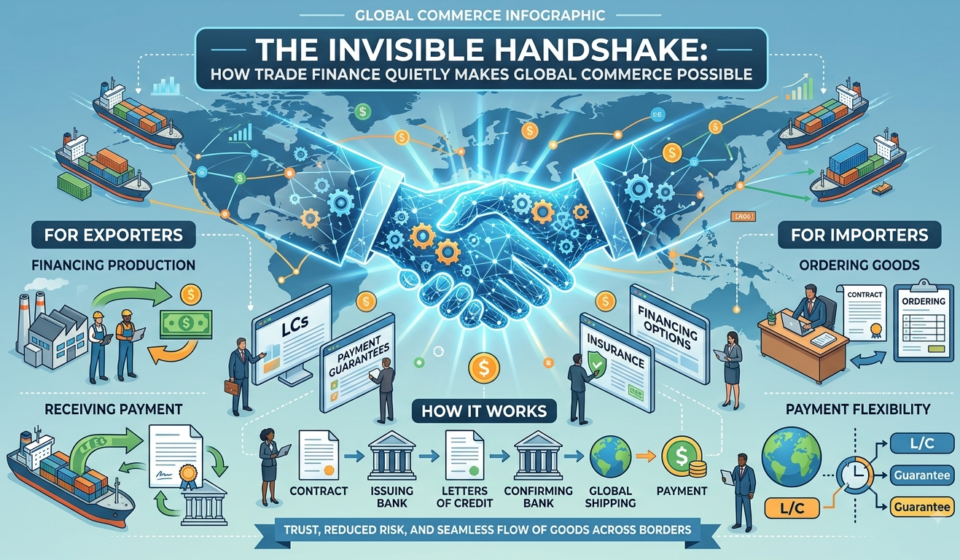
This is the problem trade finance was invented to solve. It is the collection of financial tools, instruments, and institutions that allow two parties in different parts of the world to trade with confidence, even without a personal relationship or legal recourse that would be practical to enforce across borders. Trade finance rarely makes headlines, but it is one of the quiet mechanisms that has allowed international commerce to scale from small caravans of traders to the vast, interconnected global economy we know today.
Anúncios
A Brief History of Trade Finance
Ancient Trade Networks and the Problem of Trust
Long-distance trade is almost as old as civilization itself, but it has always carried an inherent problem: how do you trust someone you may never see again, who lives in a place with different laws, different customs, and no shared legal system to enforce an agreement? Ancient trade routes, from the Silk Road connecting Asia and Europe to Mediterranean shipping lanes, required merchants to develop creative solutions to this trust problem long before formal banking existed.
Early merchants often relied on networks of trusted intermediaries, family connections, or religious and community ties to vouch for one another across long distances. Promissory notes and early forms of credit instruments began to emerge in various ancient civilizations, allowing a merchant to receive goods in one location based on a written promise of payment redeemable elsewhere, reducing the need to physically transport valuable currency across dangerous trade routes.
Anúncios
Medieval Innovations: Bills of Exchange and Letters of Credit
The medieval period, particularly in Italy, brought some of the most important early innovations in trade finance. Italian merchant bankers developed the bill of exchange, a written order instructing one party to pay a specified sum to another, often used to settle trade transactions across different cities and even different countries without the need to physically move gold or silver.
Around this same period, early forms of the letter of credit began to emerge, providing a formalized guarantee from a trusted financial institution that payment would be made to a seller once specific agreed-upon conditions were met. This innovation was transformative, because it shifted the trust required for a transaction away from the two trading parties directly, and placed it instead with a reputable financial institution that both parties could rely upon, even if they had never met each other and had no other basis for trust.
The Age of Exploration and Expanding Global Trade
As European trade expanded dramatically during the Age of Exploration, the tools of trade finance had to scale accordingly. Long ocean voyages carried enormous risk, from shipwrecks to piracy to unpredictable markets at the destination, and financing these voyages required increasingly sophisticated arrangements between merchants, financiers, and eventually chartered trading companies.
Marine insurance began developing alongside trade finance during this period, providing another layer of protection against the very real risks of transporting goods across dangerous waters. Combined with letters of credit and bills of exchange, these tools allowed trade to expand well beyond what personal trust relationships alone could have supported.
The Industrial Revolution and Formalized Banking Support
The Industrial Revolution brought a dramatic increase in the volume and complexity of international trade, as manufactured goods began moving across borders at a scale never seen before. Banks increasingly formalized their role in supporting trade, offering standardized letters of credit and other trade finance instruments as regular banking products rather than bespoke arrangements negotiated individually each time.
This period also saw growing standardization in how trade documents were prepared and processed, as the sheer volume of international transactions made ad hoc, informal arrangements increasingly impractical. Banks developed specialized trade finance departments, staffed with experts who understood the specific documentation, risks, and requirements involved in facilitating cross-border transactions.
The 20th Century and International Standardization
The 20th century brought further formalization to trade finance, driven partly by the explosive growth of international trade following both World Wars, and partly by the increasing complexity of global supply chains. International organizations and banking associations worked to standardize the rules governing trade finance instruments, particularly letters of credit, to ensure that a letter of credit issued by a bank in one country would be understood and honored consistently by parties in another country, regardless of differing local laws and customs.
This standardization was critical, because it meant a seller in one part of the world could have real confidence that a letter of credit issued by a reputable bank would function as expected, even when dealing with a buyer in a country with an entirely different legal and banking system. This shared framework became one of the quiet pillars supporting the explosive growth of global trade throughout the latter half of the 20th century.
Globalization and the Expansion of Supply Chains
As globalization accelerated in the late 20th century, supply chains grew increasingly complex, often spanning dozens of countries for a single finished product. Trade finance evolved to support this complexity, with banks and specialized finance companies developing more sophisticated tools to manage risk across multi-country supply chains, including supply chain financing arrangements that allowed suppliers to receive payment more quickly, even if the ultimate buyer’s payment terms were longer.
This period also saw the growing involvement of export credit agencies, often government-affiliated institutions designed to support businesses engaged in exporting goods internationally, providing insurance, guarantees, and sometimes direct financing to reduce the risks associated with selling into unfamiliar or higher-risk international markets.
The Digital Era and the Modernization of Trade Finance
In recent decades, technology has begun transforming an industry that, for centuries, relied heavily on physical paper documents, from bills of lading to certificates of origin. Digital documentation, electronic verification systems, and increasingly automated processing have started to streamline what was once a notoriously paperwork-heavy and time-consuming process. Financial technology companies have also entered the trade finance space, offering faster, more accessible tools, particularly valuable for smaller businesses that previously found the traditional trade finance system difficult to navigate.
Despite this ongoing modernization, the core purpose of trade finance remains exactly what it has always been: providing the trust, structure, and financial tools necessary to allow two parties, often strangers separated by vast distances and different legal systems, to trade with confidence.
What Is Trade Finance?
Trade finance refers to the various financial instruments, products, and services that facilitate international trade by reducing the risk involved for both buyers and sellers. Because international transactions often involve parties who do not know each other well, operate under different legal systems, and may be separated by significant distance and time, trade finance provides the structure and guarantees necessary to make these transactions feasible and reliable.
Letters of Credit
A letter of credit is one of the most well-known and widely used trade finance instruments. It is a formal document issued by a bank on behalf of a buyer, guaranteeing that payment will be made to a seller once specific, predetermined conditions are met, such as the delivery of goods along with proper documentation confirming the shipment. This shifts the trust required for the transaction away from the buyer directly and places it instead with a reputable financial institution, giving the seller much greater confidence that payment will be received.
Bills of Lading and Shipping Documentation
A bill of lading is a document issued by a carrier, acknowledging receipt of goods for shipment and outlining the terms under which those goods will be transported. This document plays a critical role in trade finance, as it often serves as proof that goods have been shipped and can be required before payment is released under a letter of credit or other financing arrangement.
Export and Import Financing
Export financing helps a seller receive payment more quickly, sometimes even before the buyer’s payment is due, by allowing a bank or specialized lender to advance funds based on the expected payment from the transaction. Import financing, conversely, helps a buyer obtain the funds necessary to pay for goods, often bridging the gap between when payment is due and when the buyer expects to generate revenue from reselling or using the imported goods.
Trade Credit Insurance
Trade credit insurance protects a seller against the risk of non-payment by a buyer, whether due to the buyer’s financial difficulties or broader political and economic instability in the buyer’s country. This insurance allows sellers to extend credit terms to international buyers with far greater confidence, knowing that a portion of their potential losses would be covered in the event of non-payment.
Supply Chain Financing
Supply chain financing arrangements allow suppliers within a larger supply chain to receive payment more quickly than the buyer’s standard payment terms would normally allow, often facilitated by a financial institution that essentially bridges the gap between when a supplier wants to be paid and when the buyer is contractually obligated to pay.
The Role of Export Credit Agencies
Many countries maintain export credit agencies, often government-affiliated institutions designed specifically to support domestic businesses engaged in exporting goods internationally. These agencies often provide insurance, guarantees, or direct financing, particularly for transactions involving higher-risk international markets where private financial institutions might otherwise be hesitant to provide support.
Frequently Asked Questions
What is the main purpose of trade finance?
The main purpose of trade finance is to reduce the risk involved in international trade transactions, allowing buyers and sellers who may not know each other well and operate under different legal systems to trade with greater confidence and security.
What is a letter of credit, in simple terms?
A letter of credit is essentially a guarantee from a bank that a seller will be paid once certain agreed-upon conditions, such as proof of shipment, are met. It shifts the trust required for the transaction from the buyer directly to a reputable financial institution.
Is trade finance only relevant to large multinational corporations?
No. While large corporations certainly use trade finance extensively, smaller businesses engaged in importing or exporting goods can also benefit significantly from trade finance tools, particularly as digital platforms have made these services more accessible in recent years.
What is the difference between export financing and import financing?
Export financing helps a seller receive payment sooner, sometimes before the buyer’s payment is officially due, while import financing helps a buyer obtain the necessary funds to pay for goods, often bridging the gap between the payment due date and when the buyer expects to generate revenue from those goods.
Why is trade credit insurance important?
Trade credit insurance protects sellers against the risk of non-payment, whether due to a buyer’s financial troubles or broader instability in the buyer’s country. This allows sellers to extend credit terms internationally with far more confidence than they might otherwise have.
How do export credit agencies support international trade?
Export credit agencies, often affiliated with national governments, provide insurance, guarantees, or direct financing to support businesses exporting goods internationally, particularly in higher-risk markets where private financial institutions might be more hesitant to provide support on their own.
What documents are typically involved in a trade finance transaction?
Common documents include the bill of lading, which proves goods have been shipped, along with commercial invoices, certificates of origin, and insurance certificates, among others, depending on the specific requirements of the transaction and the trade finance instrument being used.
How has technology changed trade finance?
Technology has begun to modernize an industry historically dependent on extensive physical paperwork, introducing digital documentation, electronic verification, and more automated processing, which has helped reduce the time and complexity traditionally associated with international trade transactions.
Can trade finance help a business expand into new international markets?
Yes, trade finance tools can provide businesses with the confidence and financial support needed to engage with new international buyers or suppliers, particularly in markets where the business may not yet have an established relationship or track record of trust.
Is trade finance the same as general business financing?
Not exactly. While trade finance does involve financial support, it is specifically designed to address the unique risks and challenges of international trade transactions, such as cross-border payment risk and the need for trust between unfamiliar parties, rather than general business operating expenses.
Conclusion
Trade finance rarely gets the attention it deserves, given how essential it has been to the development of global commerce. Its history stretches back to ancient trade routes where merchants first grappled with the challenge of trusting strangers across vast distances, through medieval innovations like the bill of exchange and letter of credit, and into today’s digitally supported, internationally standardized system that quietly underpins a substantial share of global trade.
At its heart, trade finance solves a problem that has existed as long as long-distance commerce itself: how do two parties, who may never meet and operate under entirely different legal systems, trust one another enough to exchange goods and payment across vast distances? The tools developed over centuries, from letters of credit to trade credit insurance, provide exactly this kind of trust, structured and formalized in a way that allows global trade to function reliably at an enormous scale.
As supply chains continue to grow more complex and international trade continues to expand, trade finance will likely keep evolving, just as it always has, ad