
Anúncios
Walk into almost any mid-sized or large company today, and somewhere behind the scenes, a single piece of software is quietly holding together everything from inventory counts to payroll to customer orders. It rarely gets a mention in company meetings unless something goes wrong, yet it is often the single most expensive and disruptive technology project a business will ever undertake. This is enterprise resource planning software, more commonly known simply as ERP, and the process of installing and adapting it to a specific business, known as ERP implementation, has become one of the defining rites of passage for growing companies.
Before ERP existed, businesses ran on a patchwork of disconnected systems, paper records, and manual processes that often did not talk to one another. A sales order placed in one system might have no automatic connection to the inventory system tracking whether the product was even in stock, or the accounting system that needed to record the transaction. ERP implementation exists to solve exactly this kind of fragmentation, bringing a company’s core processes together under a single, unified system. Understanding how it works, and how it came to be such a critical part of modern business, reveals a story of technology quietly reshaping how companies operate from the inside out.
Anúncios
A Brief History of ERP Implementation
Early Manufacturing Systems and the Roots of ERP
The origins of ERP trace back to the mid-20th century, well before the term itself existed. In the 1960s, manufacturing companies began using early computer systems to manage inventory more efficiently, giving rise to what became known as material requirements planning, or MRP. These early systems focused primarily on helping manufacturers determine what raw materials and components were needed, and when, to meet production schedules without overordering or running short.
MRP systems were groundbreaking for their time, but they were narrow in scope, focused almost entirely on manufacturing and inventory needs, and they typically ran on large, expensive mainframe computers accessible only to bigger companies with substantial technology budgets.
Anúncios
The Expansion to MRP II
By the 1980s, these systems had evolved into what became known as manufacturing resource planning, or MRP II, an expanded version that incorporated additional business functions beyond simple inventory and material planning. MRP II systems began integrating areas like production scheduling, capacity planning, and even some financial functions, reflecting a growing recognition that different parts of a manufacturing business were deeply interconnected and could benefit from being managed within a single, cohesive system rather than separate, disconnected tools.
This expansion laid essential groundwork for what would eventually become full enterprise resource planning software, as businesses and software developers alike began to see the value in connecting not just manufacturing processes, but the broader operations of an entire company.
The Birth of Modern ERP in the 1990s
The term “enterprise resource planning” itself emerged in the early 1990s, coined by an industry research firm to describe a new generation of software that extended far beyond manufacturing, incorporating finance, human resources, procurement, and other core business functions into a single, integrated system. This represented a fundamental shift in ambition: rather than simply managing inventory or production, ERP systems aimed to serve as the central nervous system for an entire organization.
Several major software companies rose to prominence during this decade, developing large, comprehensive ERP platforms designed primarily for large corporations with the budgets and technical resources necessary to implement such complex systems. Implementations during this era were often massive undertakings, sometimes taking years to complete and costing millions of dollars, as companies worked to adapt sprawling, complex software to their specific operational needs.
The Y2K Effect and Rapid Adoption
Interestingly, one of the most significant accelerants of ERP adoption in the late 1990s was the Y2K problem, the widespread concern that older computer systems using two-digit year formats would malfunction when the year 2000 arrived. Many companies used this looming deadline as an opportunity to replace aging, disconnected legacy systems with modern, integrated ERP platforms, dramatically accelerating ERP adoption across industries during this period.
This wave of adoption cemented ERP as a mainstream business technology, no longer reserved solely for the largest corporations, but increasingly adopted by mid-sized businesses as well, as software vendors began offering more scalable and configurable versions of their platforms.
The Internet Era and Web-Based ERP
As the internet became central to business operations in the 2000s, ERP systems began incorporating web-based access, allowing employees to interact with company systems from browsers rather than being tied to specific on-site terminals. This period also saw growing integration between ERP systems and other emerging technologies, such as customer relationship management software and e-commerce platforms, further expanding the scope of what a unified business system could accomplish.
Implementations remained complex and often lengthy during this period, but the increasing modularity of ERP systems allowed companies more flexibility in choosing which specific functions to implement first, rather than requiring an all-or-nothing approach.
The Cloud Computing Revolution
Perhaps the most transformative shift in the history of ERP came with the rise of cloud computing in the 2010s. Traditional ERP systems had required companies to purchase and maintain their own servers and infrastructure, a costly and technically demanding undertaking. Cloud-based ERP systems eliminated much of this burden, allowing companies to access powerful ERP software hosted remotely, with the software vendor responsible for maintaining the underlying infrastructure.
This shift dramatically lowered the barrier to entry for ERP adoption, making sophisticated, integrated business systems accessible to small and mid-sized businesses that previously could not have justified the enormous upfront investment required for traditional, on-premises ERP systems. Cloud-based ERP also introduced more flexible pricing models, often based on a subscription structure, further reducing the financial barrier to implementation.
Modern ERP and the Rise of Industry-Specific Solutions
In recent years, the ERP landscape has continued to diversify, with vendors increasingly offering industry-specific versions of their platforms, tailored to the particular needs of sectors like healthcare, retail, construction, or professional services. Modern implementations increasingly emphasize configurability, allowing businesses to adapt the system to their existing processes, rather than forcing the business to reshape its entire operation around a rigid piece of software, as was often the case in earlier decades.
Despite all this evolution, the fundamental challenge of ERP implementation has remained remarkably consistent throughout its history: successfully bringing together disparate parts of a business into a single, cohesive system requires far more than simply installing software. It requires careful planning, extensive process mapping, and significant organizational change management to succeed.
What Is ERP Implementation?
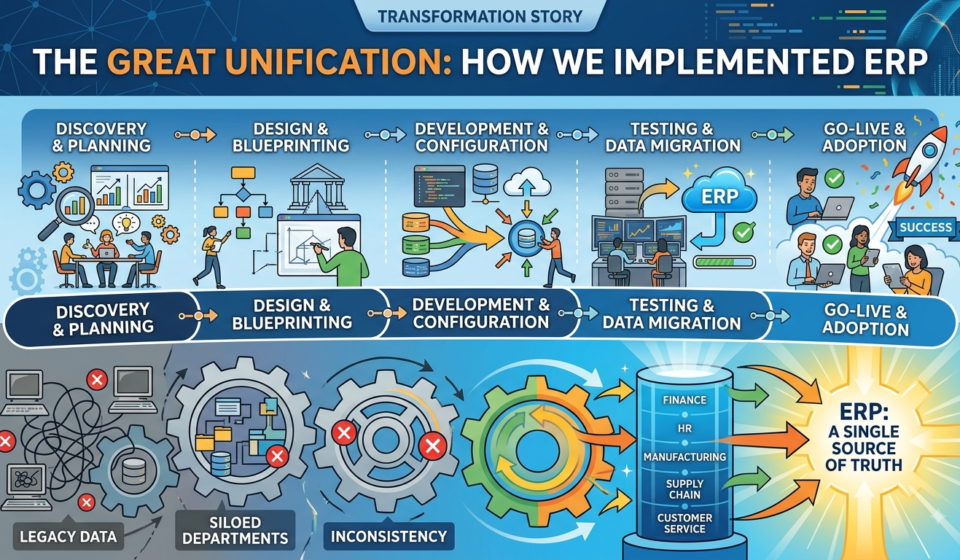
ERP implementation is the process of installing, configuring, and rolling out an enterprise resource planning system within an organization, adapting the software to fit the company’s specific processes, and training employees to use it effectively. It is distinct from simply purchasing ERP software, as implementation involves a complex series of steps that can take anywhere from a few months to several years, depending on the size and complexity of the organization.
Key Phases of ERP Implementation
Planning and discovery. Before any software configuration begins, businesses typically conduct a thorough assessment of their existing processes, identifying pain points, inefficiencies, and specific requirements that the new ERP system needs to address. This phase often involves input from multiple departments, since ERP systems are designed to serve the entire organization rather than a single function.
System selection. With a clear understanding of the company’s needs, businesses evaluate different ERP platforms to determine which best fits their industry, size, and specific operational requirements. This decision often has long-lasting implications, since switching ERP systems after implementation is a significant undertaking in its own right.
Configuration and customization. Once a system is selected, it must be configured to match the company’s specific workflows, whether that involves setting up particular accounting structures, inventory categories, or approval processes unique to the business. Some level of customization is often necessary, though heavily customized systems can become more difficult to update and maintain over time.
Data migration. Existing business data, from customer records to historical financial information, typically needs to be transferred from old systems into the new ERP platform. This step is often more complex than it initially appears, as data quality issues from legacy systems can create significant challenges if not addressed carefully.
Testing. Before the system goes live, extensive testing is typically conducted to ensure that all processes function as intended, that data has migrated correctly, and that the system can handle the actual volume and complexity of the business’s operations.
Training and change management. Perhaps one of the most underestimated aspects of ERP implementation is preparing employees to use the new system effectively. Since ERP systems often change how employees perform their daily tasks, thorough training and thoughtful change management are essential to ensuring the new system is adopted successfully rather than resisted or worked around.
Go-live and ongoing support. Once the system launches, businesses typically require a period of close monitoring and support to address any issues that arise, along with ongoing adjustments as the organization becomes more familiar with the new system.
Common Challenges in ERP Implementation
ERP implementations are notoriously challenging, and many projects face delays, budget overruns, or in some cases, outright failure. Common challenges include underestimating the complexity of the project, insufficient employee training, poor data quality carried over from legacy systems, inadequate executive support, and resistance to change from employees accustomed to existing processes. Successful implementations typically require strong project leadership, clear communication across departments, and realistic expectations about the time and resources required.
On-Premises vs. Cloud-Based Implementation
Businesses today generally choose between traditional on-premises ERP systems, which are installed and maintained on the company’s own servers, and cloud-based ERP systems, which are hosted remotely by the software vendor. On-premises systems often provide greater control and customization but require significant internal technical resources to maintain. Cloud-based systems typically offer lower upfront costs, easier maintenance, and faster implementation timelines, making them an increasingly popular choice, particularly among small and mid-sized businesses.
Frequently Asked Questions
How long does a typical ERP implementation take?
This varies significantly depending on the size and complexity of the organization, as well as how many business functions are being integrated. Smaller implementations might take a few months, while large, complex organizations implementing ERP across multiple departments and locations can take a year or more.
Why do ERP implementations often fail or run over budget?
Common causes include underestimating the complexity of aligning the software with existing business processes, insufficient employee training, poor data quality from legacy systems, and inadequate change management to help employees adapt to new workflows.
What is the difference between on-premises and cloud-based ERP?
On-premises ERP is installed and maintained on a company’s own servers, offering greater control but requiring significant internal technical resources. Cloud-based ERP is hosted remotely by the vendor, typically offering lower upfront costs, easier maintenance, and often faster implementation timelines.
Is ERP implementation only relevant for large companies?
No. While ERP was historically associated with large corporations due to high costs and complexity, the rise of cloud-based, more affordable ERP systems has made implementation increasingly accessible and common among small and mid-sized businesses as well.
What departments are typically involved in an ERP implementation?
ERP systems are designed to serve an entire organization, so implementations often involve input and participation from multiple departments, including finance, operations, human resources, sales, and inventory management, among others, depending on the specific scope of the project.
How much customization is typically needed during ERP implementation?
This varies depending on the business and the chosen software, but most implementations require at least some level of configuration to align the system with the company’s specific workflows. Heavy customization is sometimes necessary but can make future updates and maintenance more complex.
What is data migration, and why is it considered challenging?
Data migration involves transferring existing business data from old systems into the new ERP platform. It is often more complex than expected, since legacy data can include inconsistencies, duplicates, or outdated information that must be cleaned and reconciled before migration to ensure the new system functions accurately.
Why is employee training so important during ERP implementation?
ERP systems often change how employees perform everyday tasks, and insufficient training can lead to poor adoption, workarounds, or errors that undermine the benefits of the new system. Thorough training helps ensure employees understand and embrace the new processes rather than resisting them.
Can a business switch ERP systems after an initial implementation?
Yes, though it is typically a significant undertaking, similar in complexity to the original implementation, since it involves migrating data, reconfiguring processes, and retraining employees once again. Businesses generally aim to choose a system carefully upfront to avoid the need for a costly future switch.
What are the benefits of a successful ERP implementation?
A well-executed ERP implementation can significantly improve efficiency by connecting previously disconnected processes, provide better visibility into overall business operations, reduce manual errors, and support more informed decision-making through centralized, accurate data across the organization.
Conclusion
ERP implementation may not carry the same public visibility as more consumer-facing technology, but its impact on how modern businesses operate is enormous. Its history traces back to early manufacturing systems focused narrowly on inventory management, through the ambitious integrated platforms of the 1990s, and into today’s flexible, cloud-based systems accessible to businesses of nearly every size.
At its core, ERP implementation addresses a challenge that has existed in growing businesses for decades: how do you connect the many moving parts of an organization, from finance to inventory to human resources, into a single, coherent system that reflects the reality of how the business actually operates? Getting this right requires far more than simply installing software. It demands careful planning, thoughtful process design, and genuine attention to how employees will adapt to new ways of working.
As businesses continue to grow more complex and increasingly reliant on accurate, real-time data, ERP implementation will likely remain a defining, if often invisible, milestone in a company’s growth story. For those embarking on the process, understanding its history and the challenges it has always presented can offer valuable perspective on why careful planning and realistic expectations remain just as essential today as they were when the very first integrated systems began connecting the disparate pieces of a growing business.