
Anúncios
Micro, Small, and Medium Enterprises (MSMEs) form the backbone of economies around the world. From neighborhood manufacturing units and small trading firms to growing service-based startups, MSMEs contribute significantly to employment, innovation, and overall economic output. Yet, despite their importance, many of these businesses face a common and persistent challenge: access to adequate and timely financing.
This is where MSME loans come in. Designed specifically to address the unique needs of smaller businesses, these loans provide the capital required to start, sustain, or grow operations without necessarily requiring the extensive collateral or lengthy processes often associated with traditional business loans. This guide explores what MSME loans are, the types available, eligibility considerations, benefits, challenges, and answers to frequently asked questions.
Anúncios
What Is an MSME Loan?
An MSME loan is a type of financing specifically tailored for micro, small, and medium enterprises. These loans are typically offered by banks, non-banking financial companies (NBFCs), government-backed institutions, and increasingly, digital lending platforms. The classification of a business as micro, small, or medium is usually determined by factors such as annual turnover, investment in equipment or plant, and sometimes the number of employees, though the exact criteria vary by country and regulatory framework.
MSME loans are generally used for purposes such as:
Anúncios
- Purchasing raw materials or inventory
- Expanding business operations or opening new locations
- Upgrading machinery or equipment
- Managing working capital needs
- Hiring additional staff
- Investing in technology or digital infrastructure
- Bridging cash flow gaps during slow business periods
Why MSME Loans Matter
Small and medium businesses often face financing hurdles that larger corporations do not. They may lack extensive credit histories, substantial collateral, or the financial documentation that traditional lenders prefer. Recognizing this gap, many governments and financial institutions have developed specialized loan products and schemes aimed at supporting MSME growth.
These loans matter because they:
- Enable business creation and survival, especially in the crucial early years when cash flow can be unpredictable.
- Support job creation, since MSMEs are often significant employers within local economies.
- Encourage innovation and entrepreneurship, by giving smaller players the resources to compete and grow.
- Strengthen local and national economies, as a thriving MSME sector often correlates with broader economic resilience.
Types of MSME Loans
MSME financing isn’t a single, uniform product — it encompasses a range of loan types designed to meet different business needs.
1. Term Loans
These are traditional loans provided as a lump sum, repaid over a fixed period with regular installments. They are commonly used for larger investments, such as purchasing equipment or expanding facilities.
2. Working Capital Loans
Designed to cover day-to-day operational expenses, these loans help MSMEs manage cash flow gaps between expenses and incoming revenue.
3. Machinery and Equipment Loans
Specifically intended for purchasing or upgrading machinery, this type of loan is often secured against the equipment itself.
4. Trade Credit and Invoice Financing
This allows MSMEs to unlock cash tied up in unpaid invoices or negotiate better payment terms with suppliers, improving cash flow without waiting for standard payment cycles.
5. Government-Backed MSME Loan Schemes
Many countries offer specialized loan schemes with favorable interest rates, reduced collateral requirements, or credit guarantees to encourage lending to smaller businesses. These programs are often designed in partnership with banks or financial institutions to reduce the risk lenders face when serving MSMEs.
6. Overdraft Facilities
An overdraft allows a business to withdraw more money than is available in its account, up to an agreed limit, providing short-term flexibility for managing unexpected expenses.
7. Business Credit Cards
While not a traditional loan, business credit cards offer MSMEs a revolving line of credit that can help manage smaller, recurring expenses.
Eligibility Criteria for MSME Loans
While specific requirements vary depending on the lender and loan type, common eligibility factors include:
- Business registration and classification: Proof that the business qualifies as a micro, small, or medium enterprise under relevant regulatory definitions.
- Time in operation: Many lenders require a minimum period of business operation, though some schemes cater specifically to startups and newer businesses.
- Financial documentation: This may include bank statements, tax returns, profit and loss statements, and balance sheets.
- Credit history: Both the business’s credit profile and, in some cases, the personal credit history of the business owner may be considered.
- Purpose of the loan: Some loan products are tied to specific uses, such as equipment purchases or working capital needs, which may require supporting documentation.
- Collateral (if applicable): While many MSME loan schemes are designed to reduce collateral requirements, secured loans may still require assets to be pledged.
Benefits of MSME Loans
Access to Capital Without Heavy Collateral
Many MSME loan programs, particularly government-backed schemes, are designed to reduce the collateral burden on smaller businesses, making financing more accessible.
Competitive Interest Rates
Because many MSME loan schemes are supported by government guarantees or subsidies, interest rates can often be more favorable compared to standard commercial loans.
Flexible Loan Purposes
MSME loans cover a wide range of business needs, from working capital to equipment financing, allowing businesses to choose the right product for their specific situation.
Faster Processing With Digital Lenders
Many digital lending platforms and NBFCs have streamlined the application process, offering faster approvals and disbursements compared to traditional banks.
Support for Business Growth
By providing access to capital for expansion, technology upgrades, or hiring, MSME loans can help small businesses scale and compete more effectively.
Building Business Credit History
Successfully repaying an MSME loan can help build a positive credit history, which can support access to larger or more favorable financing in the future.
Challenges MSMEs Face When Seeking Loans
Despite the availability of MSME-specific financing, many small businesses still encounter obstacles:
Limited Credit History
Newer businesses or those that have primarily operated with cash transactions may lack the documented credit history that lenders typically look for.
Insufficient Collateral
Even with reduced collateral requirements, some MSMEs may still struggle to meet asset-based lending criteria.
Complex Documentation Requirements
Gathering the necessary financial statements, tax records, and business registration documents can be time-consuming, particularly for very small or informal businesses.
Awareness Gaps
Many small business owners may not be fully aware of government schemes or specialized loan products designed specifically for MSMEs, leading them to miss out on more favorable financing options.
Higher Perceived Risk
Lenders may view MSMEs as higher risk compared to larger, more established companies, which can sometimes result in higher interest rates or stricter terms for businesses that don’t qualify for subsidized schemes.
How to Improve Your Chances of Securing an MSME Loan
- Maintain organized financial records: Keeping clear, up-to-date financial statements makes the application process smoother and builds lender confidence.
- Register your business formally: Formal registration, wherever applicable, often opens access to a wider range of loan products and government schemes.
- Build a solid credit history: Paying existing debts, supplier invoices, and any prior loans on time helps strengthen both personal and business credit profiles.
- Research available schemes: Government-backed MSME loan programs often provide more favorable terms than standard commercial loans, so it’s worth exploring these options first.
- Prepare a clear business plan: For loans tied to expansion or specific investments, having a clear plan showing how funds will be used and repaid can strengthen an application.
- Compare multiple lenders: Interest rates, fees, and terms can vary significantly between banks, NBFCs, and digital lenders, so comparing options helps ensure the best fit.
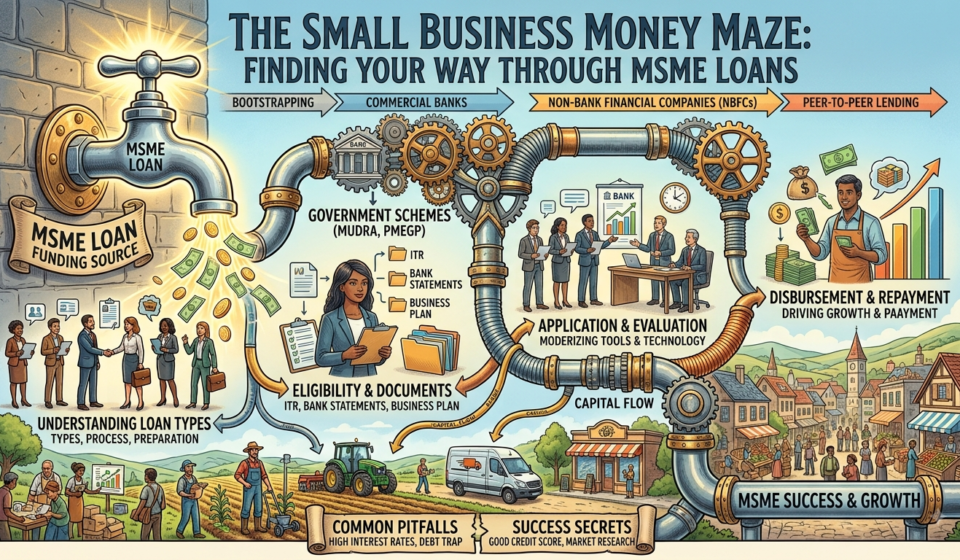
Steps to Apply for an MSME Loan
- Identify the Purpose of the Loan: Determine whether the funding is needed for working capital, equipment, expansion, or another specific business need.
- Research Loan Options: Compare traditional bank loans, NBFC products, and government-backed schemes to find the best fit for your business size and needs.
- Check Eligibility Requirements: Review criteria such as business classification, time in operation, and required documentation.
- Gather Documentation: Prepare financial statements, business registration documents, tax records, and any other required paperwork.
- Submit an Application: Apply through the chosen lender, whether via a traditional bank branch, NBFC, or online lending platform.
- Review Loan Terms Carefully: Before accepting funds, review interest rates, repayment schedules, fees, and any collateral requirements.
- Receive and Utilize Funds: Once approved, use the funds as intended, and maintain careful records for repayment and future financing needs.
Frequently Asked Questions (FAQs)
1. What qualifies a business as an MSME? Classification criteria vary by country but are generally based on factors such as annual turnover, investment in equipment or plant, and sometimes the number of employees.
2. Are MSME loans only available through government schemes? No. While many government-backed schemes exist to support MSMEs, banks, NBFCs, and digital lenders also offer dedicated loan products tailored to small and medium businesses.
3. Do MSME loans require collateral? It depends on the loan type and lender. Many MSME-focused schemes are designed to reduce collateral requirements, though secured loans may still require assets to be pledged.
4. Can a new business qualify for an MSME loan? Yes, though requirements vary. Some lenders and schemes cater specifically to startups and newer businesses, while others may require a minimum period of operation.
5. How long does it take to get an MSME loan approved? Processing times vary depending on the lender. Digital lenders and NBFCs often provide faster approvals, sometimes within a few days, while traditional banks may take longer due to more extensive documentation review.
6. What documents are typically required for an MSME loan application? Common documents include business registration proof, financial statements, tax returns, bank statements, and sometimes a business plan detailing how the loan will be used.
7. Can MSME loans be used for any business purpose? This depends on the specific loan product. Some loans, like working capital loans, offer flexible use, while others, such as equipment financing, are tied to specific purposes.
8. Are interest rates for MSME loans lower than standard business loans? Often, yes, particularly for government-backed schemes designed to support small business growth. However, rates can vary based on the lender, loan type, and the business’s credit profile.
9. What happens if an MSME cannot repay its loan? Consequences vary depending on the lender and loan terms, and may include additional fees, credit score impact, or loss of collateral for secured loans. Many lenders offer restructuring options if financial difficulties are communicated early.
10. How can I find MSME loan schemes specific to my region or country? Government economic development or small business support agencies often publish information on available MSME loan schemes, along with participating banks and financial institutions offering these programs.
Conclusion
MSME loans play a vital role in supporting the growth, stability, and resilience of small and medium businesses, which in turn contribute significantly to broader economic development. Whether it’s covering day-to-day working capital needs, investing in new equipment, or expanding operations, the right MSME loan can provide the financial foundation businesses need to thrive.
However, navigating the range of available loan products, eligibility requirements, and application processes can be challenging, especially for smaller or newer businesses. By maintaining organized financial records, exploring government-backed schemes, and carefully comparing lenders, MSMEs can improve their chances of securing favorable financing. Ultimately, with the right funding in place, small businesses can turn ambition into sustainable growth, strengthening not just their own future, but the broader economy they help power.