
Anúncios
Every business, no matter how well it is run, breathes in cycles. Money comes in waves, and expenses arrive like clockwork whether or not the cash is sitting in the bank. Payroll doesn’t wait for a slow-paying customer. Inventory doesn’t restock itself just because a big order is expected next month. It is in this gap — between when money is owed to a business and when a business owes money to someone else — that one of the most flexible financial tools ever created has thrived: the business line of credit.
Unlike a traditional loan that hands over a lump sum and starts the repayment clock immediately, a line of credit behaves more like a financial safety net that a business can dip into whenever it needs to, and step away from when it doesn’t. It is less dramatic than an investor’s check, less permanent than a bank loan, and far more forgiving than a stack of unpaid invoices. Yet despite being so common today, its story stretches back further than most people realize, evolving quietly alongside the very idea of commerce itself.
Anúncios
A Brief History of the Business Line of Credit
The Earliest Roots of Revolving Credit
The concept of extending credit that could be drawn upon and repaid repeatedly is not a modern invention. Merchants in ancient trading hubs — from Mesopotamia to the Mediterranean — often maintained running accounts with grain stores, shipping financiers, and moneylenders. A trader might borrow against an expected shipment, repay once goods were sold, and then borrow again for the next voyage. This informal cycle of borrowing and repaying was the ancestor of what we now call “revolving credit.”
Formal banking as an institution began to take shape in Renaissance Italy, where families like the Medicis built early banking networks that extended credit to merchants and rulers alike. These arrangements were often relationship-based: a trusted merchant could return to the same banking house again and again, drawing funds as needed for new ventures, provided earlier debts were settled. It was informal, deeply personal, and entirely dependent on reputation — but it planted the seed of an idea that would take centuries to formalize.
Anúncios
The Industrial Age and the Rise of Commercial Banking
As economies industrialized in the 18th and 19th centuries, businesses needed more structured and scalable ways to manage cash flow. Factories required raw materials before finished goods could be sold. Retailers needed to stock shelves before customers walked through the door. Commercial banks began offering short-term credit arrangements to merchants and manufacturers, often secured by inventory, receivables, or personal guarantees from business owners.
These arrangements were still far from standardized. Terms varied wildly from bank to bank, and access was often limited to those with strong personal connections to a banker. Still, the core mechanic — borrow, repay, borrow again — was becoming a recognizable feature of commercial banking.
The 20th Century: Formalization and Standardization
The real transformation came in the 20th century, as banking regulation matured and financial products became more standardized. After the upheavals of the Great Depression, banking systems in many countries were restructured with clearer rules around lending, interest rates, and credit assessment. This gave rise to more formalized products, including revolving credit facilities for businesses.
By the mid-20th century, commercial banks were offering structured lines of credit to businesses of varying sizes, particularly in the United States and Western Europe. These were often tied to a business’s assets or receivables and were reviewed periodically, much like they are today. The 1950s and 1960s also saw the birth of consumer credit cards, and the underlying revolving-credit technology used for those products eventually influenced how business credit lines were structured and marketed.
The Computer Age and Credit Scoring
The 1980s and 1990s brought a seismic shift with the rise of computerized credit scoring and underwriting. Where once a banker’s personal judgment and relationship with a business owner determined access to credit, algorithms and standardized scoring models began to play a larger role. This made lines of credit more accessible to a broader range of businesses, not just those with decades-long relationships with a single bank.
Small and medium-sized enterprises, which previously struggled to get the same attention as large corporations, found new doors opening. Automated underwriting reduced the time it took to assess a business’s creditworthiness, and lines of credit became a mainstream financial product rather than a privilege reserved for the biggest players.
The Fintech Era
The most dramatic transformation, however, happened in the last fifteen to twenty years with the rise of financial technology companies. Online lenders began offering business lines of credit with faster approvals, more flexible qualification criteria, and digital-first applications that could be completed in minutes rather than weeks. Traditional banks, faced with this new competition, modernized their own offerings, often partnering with technology providers to speed up their processes.
Today, a business owner can apply for a line of credit from a laptop, receive a decision within hours, and have funds available almost immediately, a stark contrast to the multi-week process that was once standard. The core idea, however, remains unchanged from centuries past: give a business the ability to borrow and repay repeatedly, so that cash flow gaps do not become existential threats.
What Is a Business Line of Credit?
At its core, a business line of credit is a flexible financing arrangement that gives a business access to a set amount of funds, which it can draw from as needed, rather than receiving one lump sum upfront. Think of it as a reusable pool of capital, similar in spirit to a credit card, but generally designed for larger amounts and business-specific needs.
Here is how it typically works in practice:
A credit limit is established. Based on the business’s revenue, credit history, time in operation, and financial health, a lender approves a maximum borrowing amount. This could range from a modest sum for a small operation to a substantial figure for a larger enterprise.
Funds are drawn as needed. The business does not have to withdraw the entire limit at once. It might draw a portion to cover a payroll shortfall one month, and a different amount a few months later to purchase inventory ahead of a seasonal rush.
Interest is charged only on what is borrowed. Unlike a term loan, where interest accrues on the full loan amount from day one, a line of credit typically charges interest only on the outstanding drawn balance, not on the unused portion of the credit limit.
Repayment replenishes availability. As the business repays what it has borrowed, that amount becomes available to borrow again, creating a revolving cycle of access.
The relationship can continue indefinitely. Many lines of credit are reviewed periodically and can be renewed, meaning a well-managed line can serve a business for years.
Secured vs. Unsecured Lines of Credit
Lines of credit generally fall into two broad categories. A secured line of credit is backed by collateral, such as business assets, equipment, or accounts receivable. Because the lender has something to fall back on if the business fails to repay, secured lines often come with more favorable terms and higher limits.
An unsecured line of credit does not require specific collateral, though it often demands a stronger credit profile and may come with a personal guarantee from the business owner. Because the lender is taking on more risk, unsecured lines might carry higher interest rates or lower limits compared to secured options.
Common Uses for a Business Line of Credit
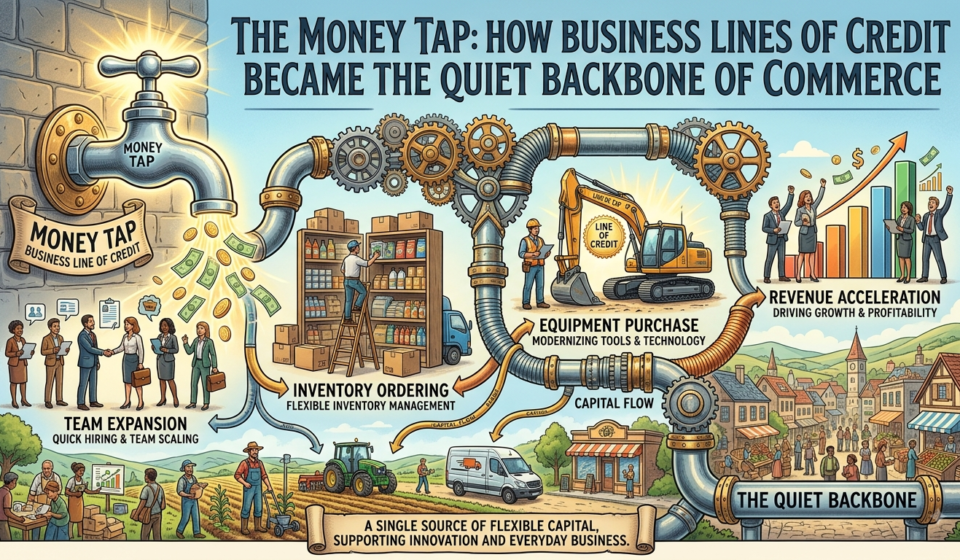
Businesses turn to lines of credit for a wide variety of reasons, and the flexibility is precisely what makes the product so popular. Common uses include:
- Managing seasonal cash flow fluctuations, such as stocking up on inventory before a busy season
- Covering payroll during a temporary gap in incoming revenue
- Bridging the time between issuing an invoice and actually receiving payment from a customer
- Handling unexpected expenses, such as equipment repairs
- Taking advantage of a time-sensitive business opportunity, like a bulk discount from a supplier
- Smoothing out operations during periods of rapid growth, when expenses often outpace incoming cash
How It Differs From a Term Loan
It’s worth pausing to clarify how a line of credit differs from a more traditional business term loan, since the two are often confused. A term loan provides a single lump sum upfront, which is then repaid over a fixed schedule with a set interest rate, much like a mortgage. It is best suited for large, one-time investments, such as purchasing equipment or expanding a facility.
A line of credit, by contrast, is designed for ongoing, recurring needs. It does not require the business to know exactly how much money it will need or when. Instead, it offers a standing resource that can be tapped into and repaid as circumstances demand.
Frequently Asked Questions
What is the difference between a business line of credit and a business credit card?
Both are revolving forms of credit, but they differ in purpose and structure. A business credit card is typically used for everyday purchases and often comes with rewards programs, while a line of credit usually offers larger amounts of cash that can be withdrawn directly, often at a lower interest rate, and is better suited for larger operational needs like covering payroll or bridging cash flow gaps.
How much can a business typically borrow with a line of credit?
This varies enormously depending on the lender, the size of the business, its revenue, and its credit profile. Smaller businesses might qualify for a modest limit, while larger, well-established companies with strong financials could be approved for a much larger facility. There is no universal number, as each lender sets its own criteria.
Do I need collateral to get a business line of credit?
Not always. Unsecured lines of credit exist and do not require specific collateral, though they may come with stricter qualification requirements or a personal guarantee. Secured lines require collateral, such as receivables or equipment, and often offer better terms in exchange.
Does a business need to be profitable to qualify?
Profitability helps, but it is not always a strict requirement. Lenders typically look at a combination of factors, including revenue, time in business, cash flow patterns, and credit history. A business with strong revenue but thin margins might still qualify, depending on the lender’s criteria.
How is interest calculated on a line of credit?
Interest is generally charged only on the amount actually drawn, not on the total credit limit. So if a business has a large limit but only borrows a small portion, it pays interest on that smaller amount, not the entire facility. Rates can be fixed or variable depending on the lender and the terms of the agreement.
Can a line of credit affect a business’s credit score?
Yes. How a business manages its line of credit, including how much of the limit it uses and whether payments are made on time, can influence its credit profile. Using a large portion of the available credit consistently, known as high utilization, may be viewed less favorably than maintaining a lower balance relative to the limit.
Is a business line of credit the same as a personal line of credit?
No. A business line of credit is extended to a business entity and is typically used for business expenses, while a personal line of credit is extended to an individual for personal use. Some small business owners, particularly sole proprietors, may use personal credit in the early stages of their business, but as a business grows, a dedicated business line of credit is generally more appropriate and helps separate personal and business finances.
What happens if a business does not use the entire credit line?
Nothing negative typically happens if the full amount is not used. Many businesses maintain a line of credit as a safety net and only draw upon it when needed. Some lenders may charge a small maintenance or non-usage fee, but this varies by institution and agreement.
Can a line of credit be renewed or increased over time?
Yes, in many cases. As a business builds a track record of responsible borrowing and repayment, lenders may offer to increase the credit limit or renew the facility for another term. This is one of the reasons a well-managed line of credit can become a long-term financial tool rather than a one-time solution.
Are there risks associated with using a business line of credit?
Like any form of credit, there are risks if it is mismanaged. Relying too heavily on a line of credit to cover ongoing losses, rather than temporary cash flow gaps, can lead to a cycle of debt that becomes difficult to escape. It works best as a tool for managing timing differences in cash flow, not as a substitute for a sustainable business model.
Conclusion
The business line of credit is one of those financial tools that rarely makes headlines, yet quietly supports an enormous share of everyday commerce. Its history reflects the broader story of how lending has evolved — from personal, reputation-based arrangements between merchants and bankers centuries ago, to today’s fast, technology-driven facilities that can be approved and accessed within hours.
What makes it endure is its simplicity and adaptability. Businesses do not always know exactly when they will need extra cash or how much, and a line of credit meets that uncertainty with flexibility rather than rigidity. It bridges the timing gaps that are simply part of doing business — the space between an invoice sent and a payment received, between a slow season and a busy one, between an opportunity and the cash needed to seize it.
For business owners considering this tool, the key lies in understanding its purpose. A line of credit is not meant to fund a business that is fundamentally unprofitable, nor is it a substitute for sound financial planning. Used thoughtfully, however, it can be the difference between a temporary cash crunch becoming a crisis, or simply becoming a manageable bump in the road. In a