Betting on Tomorrow: The Story Behind How Startups Get Their First Dollar

Anúncios
Every business that has ever changed the world began the same way: as an idea with no money behind it. Somewhere between a garage, a dorm room, or a late-night conversation, someone believed in something enough to chase it, but belief alone does not pay for engineers, servers, factories, or rent. It is money — often someone else’s money — that turns a sketch on a napkin into a company with employees, products, and customers.
Startup funding is the umbrella term for this process: the various ways a new company raises the capital it needs to survive its earliest and most fragile years. It is a world with its own language, rituals, and characters — angel investors, venture capitalists, term sheets, valuations, and pitch decks — but underneath all the jargon lies a very old idea. Someone with money is placing a bet on someone with a vision, hoping that vision pays off for both of them.
Anúncios
A Brief History of Startup Funding
Early Patronage and Merchant Risk-Taking
Long before the term “startup” existed, the concept of funding a risky new venture in exchange for a share of future rewards was already alive. Merchant voyages in ancient and medieval times were often financed by wealthy patrons or groups of investors who pooled money to fund a ship’s journey, sharing in the profits if the cargo returned safely, and absorbing the loss if it did not. This was, in essence, an early form of venture investing: capital in exchange for risk and potential reward.
Renaissance-era banking families extended this idea further, financing everything from shipbuilding to exploration voyages, understanding that most ventures might fail, but a single successful one could generate extraordinary returns. This asymmetry between the downside and the upside is a principle that still defines venture funding today.
Anúncios
The Industrial Revolution and the Rise of the Entrepreneur
As economies industrialized in the 18th and 19th centuries, a new kind of financing emerged to support entrepreneurs building factories, railroads, and manufacturing operations. Wealthy individuals, often called financiers or industrialists, began investing directly in promising ventures, sometimes taking an active role in guiding the business. Banks also grew more willing to lend to entrepreneurs with viable business plans, though access was often limited to those with connections or existing wealth.
This era planted an important seed: the idea that outside capital, rather than personal savings alone, could fuel new business creation on a large scale.
The Birth of Modern Venture Capital
The most significant turning point came in the mid-20th century, particularly in the United States. After the Second World War, a group of investors began formalizing the practice of funding early-stage companies in exchange for equity ownership. One of the earliest organized venture capital firms was founded in Boston in 1946, created specifically to fund promising businesses run by returning war veterans and entrepreneurs who lacked traditional access to bank loans.
This marked a shift from informal, relationship-based investing to a more structured model, where professional investors raised pools of capital specifically earmarked for high-risk, high-reward startup investments. Over the following decades, this model matured, with dedicated venture capital firms emerging to specialize in identifying, funding, and nurturing early-stage companies.
Silicon Valley and the Technology Boom
The real explosion of startup funding as we know it today is deeply tied to the rise of Silicon Valley in the second half of the 20th century. As semiconductor, computing, and later internet technology companies began to emerge, venture capital found its natural home. Investors realized that technology startups, unlike traditional manufacturing businesses, could scale extraordinarily quickly with relatively modest capital, offering the potential for enormous returns.
Throughout the 1970s, 1980s, and 1990s, venture capital became increasingly institutionalized. Firms raised larger funds, built specialized expertise in evaluating technology businesses, and developed the now-familiar structure of funding rounds, from initial seed investments to later, larger rounds as a company grew and proved itself.
The dot-com boom of the late 1990s brought a massive surge of capital into startup funding, followed by a dramatic crash in the early 2000s when many companies proved unable to sustain their inflated valuations. This period, while painful, ultimately refined the industry, pushing investors toward more disciplined evaluation of business fundamentals rather than pure hype.
The Rise of Angel Investing and Accelerators
In parallel with institutional venture capital, a more informal category of funding grew in prominence: angel investing. Wealthy individuals, often successful entrepreneurs themselves, began investing their own personal capital into early startups, frequently at a stage too early or too small for traditional venture firms to consider. Angel investors often brought not just money, but mentorship and industry connections.
The 2000s also saw the emergence of startup accelerators, structured programs that provided small amounts of funding along with mentorship and resources in exchange for equity, typically over a fixed period culminating in a pitch event to a room full of investors. These programs helped formalize and democratize access to early funding, giving founders without existing networks a structured path to raise their first capital.
The Crowdfunding and Fintech Era
The most recent chapter in the history of startup funding has been shaped by technology once again, this time by the internet’s ability to connect founders directly with large numbers of everyday backers. Crowdfunding platforms allowed entrepreneurs to raise money directly from the public, often in exchange for early access to a product rather than equity ownership. Equity crowdfunding later emerged as well, allowing everyday individuals, not just wealthy accredited investors, to buy small stakes in early-stage companies.
Alongside this, online platforms and networks made it easier than ever for founders to connect with angel investors and venture capitalists across the globe, breaking down some of the geographic concentration that once made hubs like Silicon Valley so dominant. Today, a founder in nearly any part of the world can, in theory, pitch investors thousands of miles away without ever boarding a plane.
What Is Startup Funding?
Startup funding refers to the capital a new company raises to finance its growth, typically in exchange for equity, debt, or some hybrid of the two. Unlike a loan from a bank, most startup funding, particularly at the earliest stages, does not require the company to have steady revenue or hard collateral. Instead, investors are betting on the potential of the idea, the strength of the founding team, and the size of the market opportunity.
Funding generally arrives in stages, often referred to as rounds, each designed to fuel the company through its next phase of growth.
Pre-Seed and Seed Funding
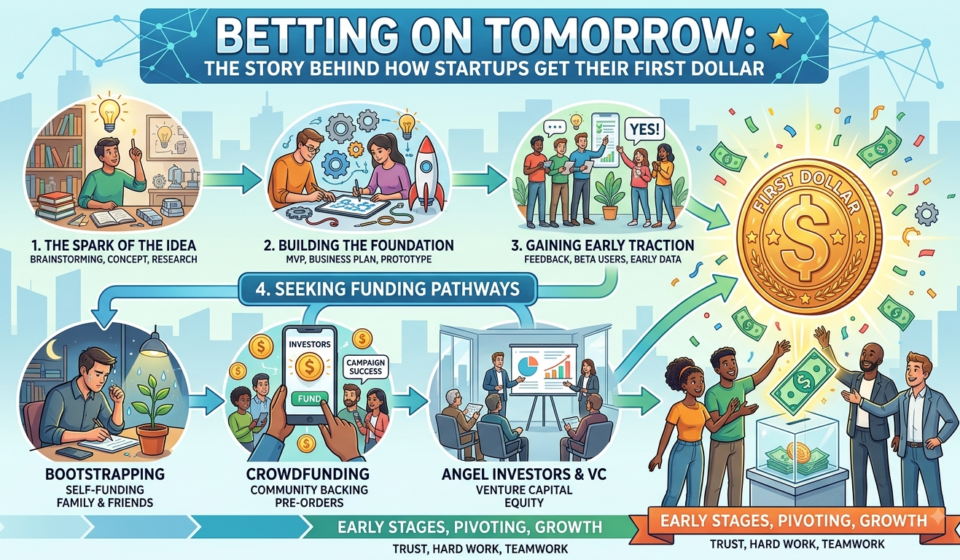
The earliest stage of funding is often used simply to prove that an idea has merit. This might come from personal savings, family and friends, or angel investors willing to take a chance on an unproven concept. Seed funding typically helps a founder build an initial product, hire a small founding team, and begin testing whether real customers want what they are building.
Series A, B, and Beyond
As a company demonstrates traction, whether through user growth, revenue, or other meaningful milestones, it may raise subsequent rounds of funding, often labeled Series A, Series B, Series C, and so on. Each successive round is typically larger than the last, reflecting the company’s reduced risk and increased proof of viability. These rounds usually come from venture capital firms and are used to scale operations, expand into new markets, or build out a larger team.
Equity vs. Debt Financing
Most startup funding, particularly from venture capital and angel investors, comes in the form of equity financing, meaning investors receive an ownership stake in the company in exchange for their capital. This aligns investor and founder incentives, since both benefit if the company succeeds, but it also means founders give up a portion of ownership and control.
Debt financing, by contrast, involves borrowing money that must be repaid, typically with interest, regardless of whether the company succeeds. Some startups use a hybrid instrument, often in the form of convertible notes or similar agreements, which start as debt but convert into equity under certain conditions, usually at the next funding round.
Non-Dilutive Funding
Not all startup funding requires giving up ownership. Grants, competitions, certain government programs, and revenue-based financing arrangements allow a company to raise money without diluting the founders’ equity stake. These sources are often more limited in size but can be valuable, particularly for founders wary of giving away too much of their company too early.
What Investors Look For
While every investor has their own criteria, most evaluate startups based on a combination of factors: the size and growth potential of the market, the strength and experience of the founding team, early signs of traction such as user growth or revenue, the uniqueness of the product or technology, and the potential for the business to scale efficiently. Because most startups fail, investors typically build a portfolio of many investments, expecting that a small number of successes will generate outsized returns that outweigh the losses from the rest.
Frequently Asked Questions
What is the difference between an angel investor and a venture capitalist?
An angel investor is typically a wealthy individual investing their own personal money, often at the earliest stages of a company, sometimes with more flexible terms and a personal mentorship relationship with the founder. A venture capitalist works for a firm that manages pooled money from other investors, known as limited partners, and typically invests larger amounts at slightly later stages, with more formal processes and governance requirements.
Do all startups need to raise outside funding?
No. Some companies, often called bootstrapped businesses, grow using only their founders’ personal savings and revenue generated by the business itself, avoiding outside investors entirely. This path allows founders to retain full ownership and control, though it can also limit the pace at which a company can grow compared to a well-funded competitor.
How much equity does a founder typically give up when raising funding?
This varies significantly depending on the stage, the amount raised, and the valuation of the company at the time. Earlier rounds tend to involve giving up a smaller slice relative to the amount raised if the valuation is strong, though founders often give up meaningful ownership across multiple rounds as the company grows. There is no fixed percentage, as every deal is negotiated individually.
What is a valuation, and how is it determined?
A valuation is an estimate of what a company is worth at a given point in time, which determines how much equity an investor receives in exchange for their investment. Valuations for early-stage startups are often more art than science, based on factors like market size, team strength, comparable company valuations, and investor demand, since the company may not yet have significant revenue or profit to base the number on.
What happens if a startup fails after raising funding?
If a startup fails, investors typically lose the money they invested, since equity investments generally do not come with a guarantee of repayment. This is why investors diversify across many startups, accepting that most will not succeed, in exchange for the chance that a few will generate substantial returns.
Is crowdfunding a reliable way to raise startup capital?
Crowdfunding can be an effective way to raise money, validate demand for a product, and build an early community of supporters, but it is not guaranteed to succeed and often requires significant marketing effort to reach potential backers. Equity crowdfunding, in particular, comes with its own regulatory requirements that vary depending on the region.
Can a startup raise funding without a finished product?
Yes, particularly at the earliest stages. Many pre-seed and seed investors fund companies based on a strong idea, a compelling founding team, and early market signals, rather than requiring a fully built product. As a company progresses to later funding rounds, however, investors typically expect a working product and some evidence of traction.
What is a pitch deck, and why does it matter?
A pitch deck is a concise presentation founders use to explain their business to potential investors, typically covering the problem being solved, the proposed solution, the market opportunity, the business model, the team, and the funding being sought. A clear, compelling pitch deck is often a founder’s first impression with an investor and can significantly influence whether a conversation moves forward.
How long does it typically take to raise a funding round?
This varies widely depending on the market environment, the strength of the company, and the investor’s own process, but raising a round can take anywhere from a few weeks to several months. Founders often begin fundraising well before they expect to run out of money, since the process can take longer than anticipated.
Is startup funding only relevant to technology companies?
While technology companies have historically dominated venture capital funding due to their potential for rapid scaling, startup funding exists across many industries, including healthcare, consumer products, food and beverage, and manufacturing. The specific funding sources and expectations may differ, but the underlying principle of raising outside capital to fuel early growth applies broadly.
Conclusion
Startup funding is, at its heart, a story about shared risk and shared belief. It stretches back to merchant voyages financed by hopeful patrons, evolved through the rise of formal venture capital in the mid-20th century, and has been reshaped again and again by new technologies, from the internet boom to today’s crowdfunding platforms.
What has remained constant throughout this evolution is the basic exchange at its core: an investor provides capital, and in return, receives a stake in a future that does not yet exist. For founders, understanding the landscape of funding options, from angel investors and venture capital to crowdfunding and non-dilutive grants, is essential to choosing a path that aligns with their goals, their industry, and how much control they are willing to share.
There is no universal formula for how a startup should raise money, and not every company needs outside funding at all. But for those chasing ideas big enough to require more capital than they can generate on their own, startup funding remains what it has always been: a bet placed by someone willing to believe in tomorrow, long before the rest of the world catches on.